


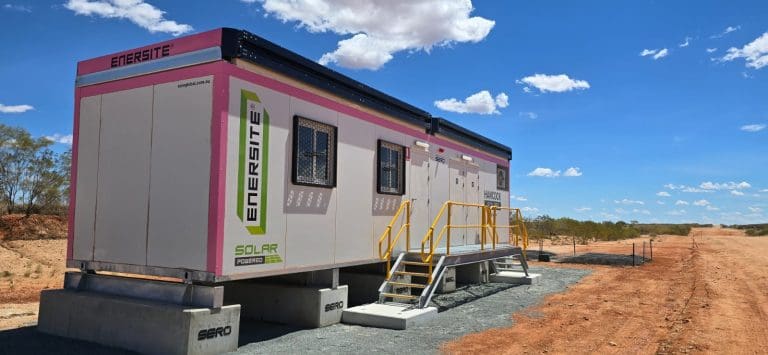
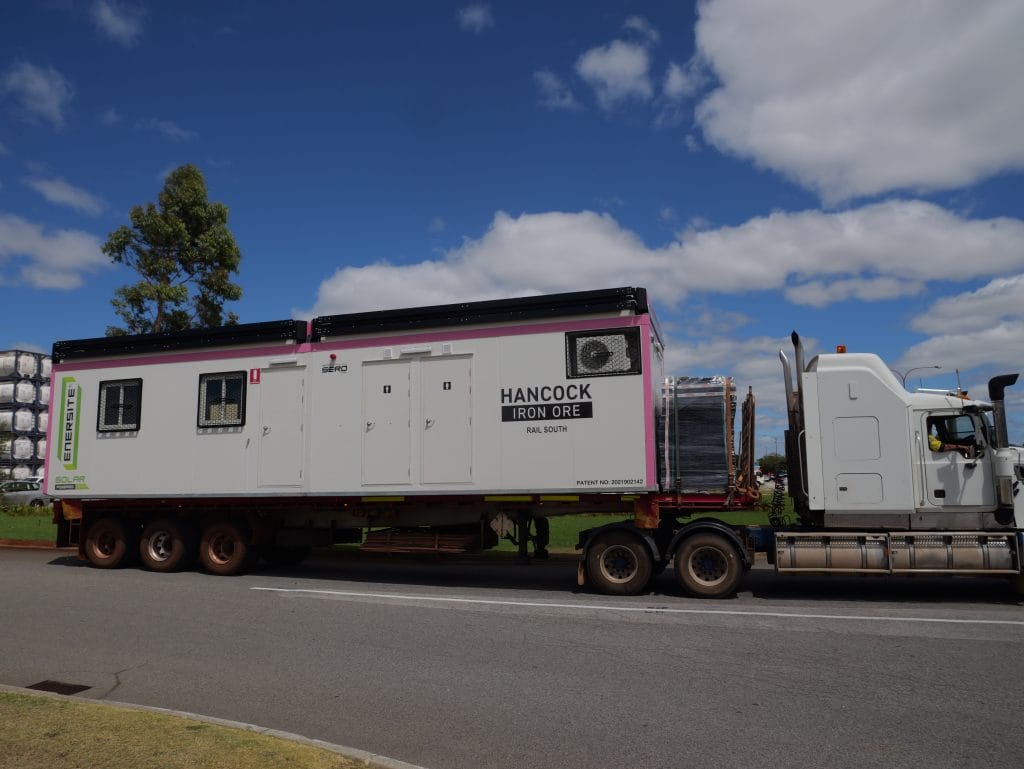
On a remote WA site, the building is rarely the hard part. Power, water and waste are. A standard donga still needs a generator running all day, a water cart, and someone to empty the septic. A solar site office removes most of that, as long as you choose the right one.
This guide covers how solar site offices and crib rooms work, where they make sense, and what to check before you buy.
What is a solar site office?
A solar site office is a transportable building that makes its own power from roof-mounted solar panels and stores it in batteries, so it runs without a diesel generator or mains connection. The best units go further and carry their own water and wastewater systems, so the building is fully self-contained.
At SERO Global, our [ENERSITE range] is built this way. The ENERSITE 12000 combines an air-conditioned office, a crib room and toilets in one 12 x 3m module. Our patented design puts solar power, potable water and wastewater treatment in the same building, so it works the day it’s placed.
How does it keep running at night?
During the day, the panels power the building and charge the batteries at the same time. At night, the batteries take over.
The question to ask any supplier is how long the batteries last without sun. SERO units carry enough storage for 72 hours of redundancy, so a run of cloudy days or a 24-hour roster won’t shut the office down. As a guide, our facilities need around four hours of peak sunlight a day, which most of WA gets comfortably.
If the solar system ever needs repair, most of our products have an external power inlet, so you can plug in a temporary generator and keep working.
When does solar beat diesel?
Solar makes the most sense when three things are true:
- There’s no mains power on site, or connecting it would be slow and expensive.
- The building will be used for months or years, not weeks. Solar costs more upfront, so the savings build over time.
- Fuel and servicing are a real cost. Every litre of diesel has to be bought, trucked in, stored and refuelled, and generators need regular servicing.
The day-to-day “fuel” for a solar office is free, and with few moving parts there’s far less to maintain. Panels usually need a clean once or twice a year, more often in dusty areas.
To see the numbers for your own site, try our SAVINGS CALCULATOR
When solar isn’t the right call
We’ll be straight with you: if your site already has reliable mains power, a traditional building is usually the cheaper option. The payback on solar equipment comes from replacing diesel. Most of the SERO range can also be supplied mains-powered, so you still get the self-contained design without paying for solar you don’t need.
What to check before you buy
Use this list when comparing suppliers:
- Battery redundancy. How many hours or days without sun? Ask for the figure in writing.
- Panel and battery warranties. SERO panels carry a minimum 25-year replacement warranty and batteries a 10-year warranty.
- Water and waste. Is the building truly self-contained, or will you still need separate tanks, pumps and pump-outs?
- Remote monitoring. Can you see output, battery level and fault alerts from the office? On SERO products it’s standard or an option.
- Backup power. Is there an inlet for a generator if something goes wrong?
- Site conditions. Heat, dust and wind ratings should match your location, especially in cyclonic regions.
- Layout options. Can the supplier change the internal layout, or only sell standard units?
- Service and support. Who maintains it, and how fast can they get to site?
How long does it take?
Lead times depend on size, quantity and customisation. As a guide, SERO buildings of 6 x 3m and larger take around 10 to 14 weeks. Smaller equipment that isn’t in stock takes around 4 to 6 weeks. If you’re working to a fixed shutdown or mobilisation date, tell us early and we’ll plan the schedule with you.
Delivery, installation and support
Because our facilities are self-contained, setup is quick: place the module and it’s ready to use. When the job moves, it can be relocated and back in operation straight away.
We design and manufacture everything in-house in Maddington, WA, so we can customise layouts and scale power systems to your site. We can also handle installation and commissioning, offer 24-hour phone support, and run scheduled maintenance to keep systems at full output.
See it working
SERO facilities are already in use on WA mine, rail and port sites. View projects HERE.
Talk to us about your site
Every remote site is different. Tell us where you’re working, how many people you need to support, and for how long, and we’ll recommend the right setup. Call 1300 033 066, email info@seroglobal.com.au, or [send an enquiry]. All quotes are obligation-free.
FAQ block (add as FAQ schema)
- Can a solar site office run 24/7? Yes. Batteries charged during the day power the building overnight, with 72 hours of redundancy on SERO units.
- How much sun does it need? Around four hours of peak sunlight a day.
- What if there’s no sun for days? The batteries cover 72 hours, and a generator can be connected through the external power inlet.
- Is solar worth it if I have mains power? Usually not. A mains-powered SERO unit is the better choice there.
